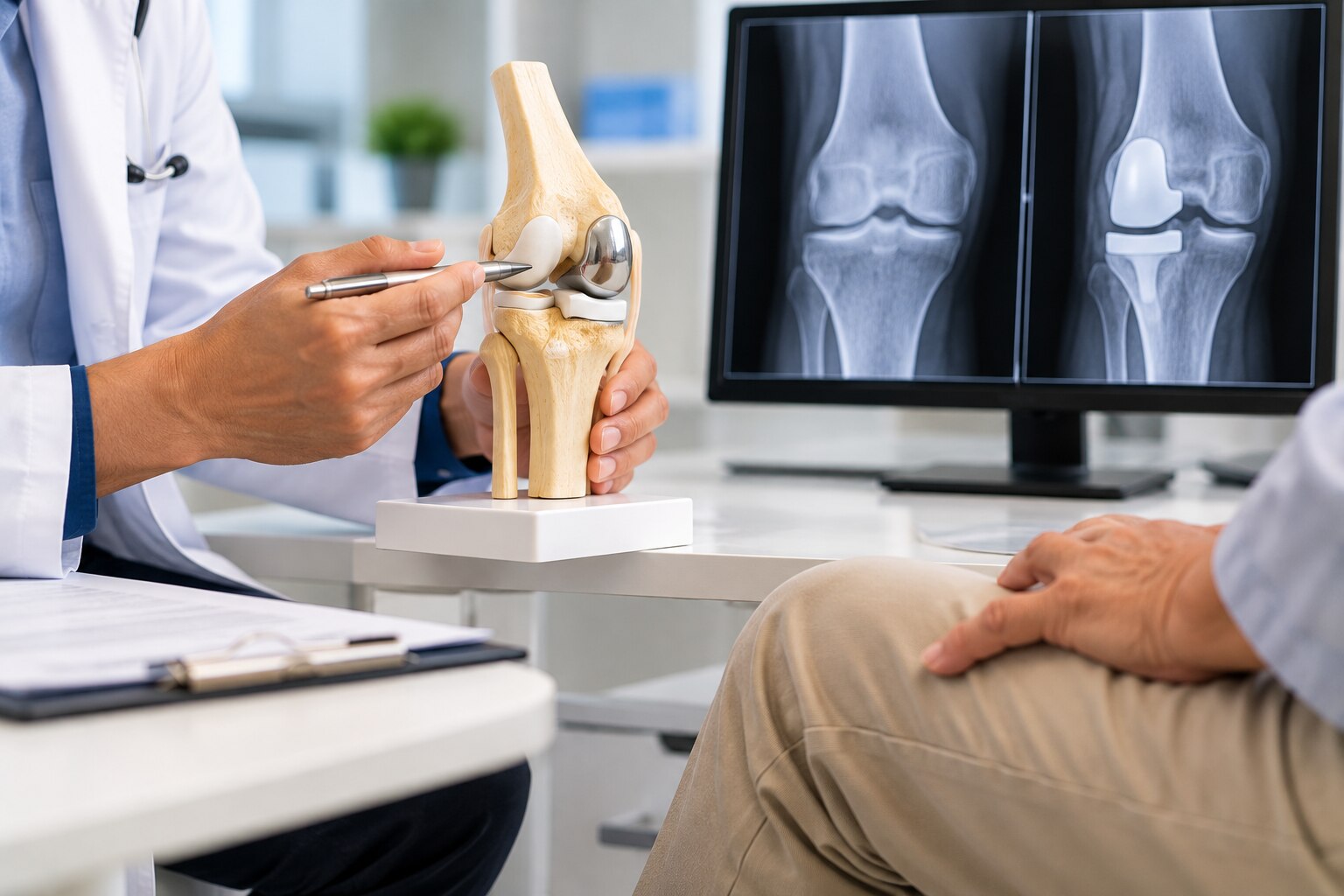
Choosing a partial knee replacement depends on more than an X-ray or the fact that pain is worse on one side. You will learn how the diagnosis is confirmed, how surgeons decide between partial and total replacement, what happens in the operating room, and what safe recovery involves.
Key takeaways
- MRI and weight-bearing X-rays help identify the damaged knee compartment.
- Partial replacement suits isolated arthritis with healthy remaining compartments and stable ligaments.
- The operation resurfaces one compartment while preserving more of your natural knee.
- Plan wound care, exercises, walking support, and follow-up before discharge.
What happens during the consultation and investigation?
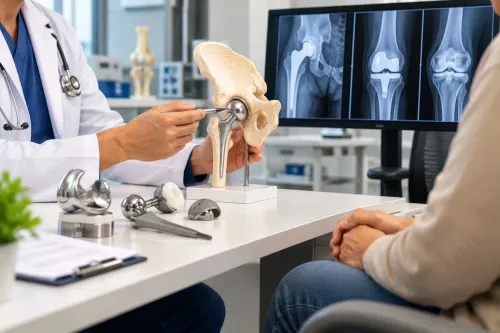
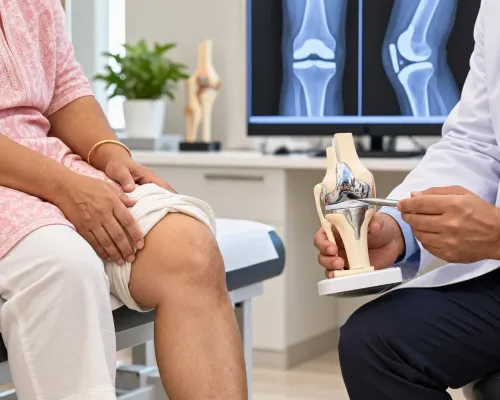
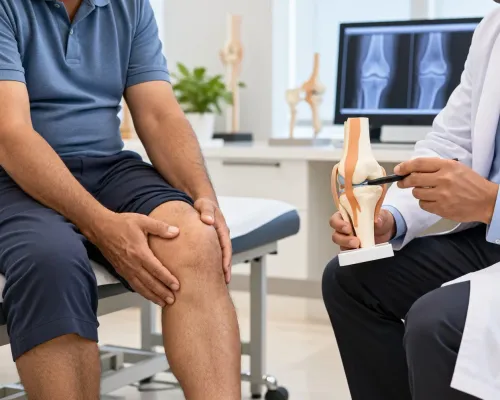
A surgeon recommends partial knee replacement only when your pain matches arthritis in one knee compartment and the remaining joint is suitable for preservation. A partial knee surgery consultation in Worli should therefore establish the pain source, map the damage, and test whether the knee can support a stable, correctable reconstruction.
The assessment usually includes:
- Your pain history: location, duration, swelling, night pain, and activities that trigger symptoms.
- Walking and activity review, including limp, walking distance, stairs, work, and sport.
- Examination for tenderness, range of motion, alignment, and deformity.
- Ligament testing, especially the anterior cruciate ligament and collateral ligaments.
- Checks for pain arising from the hip, spine, bursae, tendons, or another knee structure.
- Review of physiotherapy, medicines, injections, weight management, and other treatment already tried.
- Standing weight-bearing X-rays to show joint-space loss under load.
- Long-leg alignment X-rays when the surgeon needs to measure the entire leg’s mechanical axis.
- MRI when cartilage, the opposite compartment, the kneecap compartment, or ligament condition remains unclear.
The images must match your symptoms and examination; an X-ray alone cannot establish suitability. Partial replacement becomes more plausible when arthritis is confined to the medial, lateral, or patellofemoral compartment, major ligaments are intact, bone quality is adequate, and any deformity can be corrected during assessment.
Widespread arthritis, severe stiffness, or instability points away from it.
How do surgeons decide between partial and total knee replacement?
If you searched for partial knee replacement procedure worli, the key question is whether damage is truly confined to one compartment. Partial replacement suits pain that matches medial, lateral, or patellofemoral arthritis, with an intact ACL and other major ligaments, correctable alignment, sound bone, and useful cartilage elsewhere.
| Option | Clinical picture | Imaging and health clues |
|---|---|---|
| Partial replacement | Symptoms and wear stay mainly in one compartment; the knee remains stable and the deformity can be corrected. | Standing weight-bearing X-rays show preserved opposite compartments; long-leg films confirm acceptable alignment. MRI helps when cartilage or ligament status is uncertain. |
| Total replacement | Arthritis affects two or three compartments, or pain does not match one isolated area. | X-rays show widespread joint-space loss, while MRI can reveal hidden cartilage or ligament damage. |
| Total replacement | Inflammatory arthritis, major ligament insufficiency, severe fixed deformity, or poor bone support makes a partial implant less forgiving. | Bone loss or instability on imaging supports resurfacing all three compartments; overall health and rehabilitation capacity also influence safety. |
A partial implant is less suitable when the knee is unstable, the deformity cannot be corrected, or arthritis is likely to progress in another compartment. Total replacement is usually safer when those problems make alignment and load-sharing unreliable.
Diabetes, heart or lung disease, blood-thinning medication, and limited home support affect anaesthesia and recovery planning for either operation, but they do not automatically determine the implant choice. Robotic assistance can improve planning; it cannot overcome unsuitable ligaments, bone, or disease distribution.
What happens during the partial knee replacement operation?
Whether you search partial knee surgery steps worli or ask your surgical team directly, the operating sequence follows the same core stages.
1. Anaesthesia is given after you enter the operating room. This may be spinal or general anaesthesia, sometimes combined with a nerve block for pain relief. The team checks your identity, surgical knee, medicines, allergies, and monitoring equipment before positioning you.
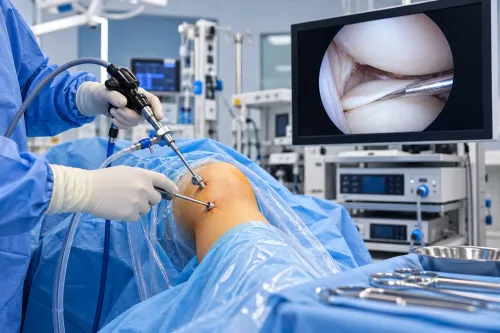
2. The leg is cleaned with antiseptic and covered with sterile drapes. The surgeon makes a smaller incision than a typical total knee replacement, exposes the affected medial, lateral, or patellofemoral compartment, and protects the healthy compartments and ligaments.
3. Damaged cartilage and a small amount of bone are removed. Cutting guides, instruments, or computer-assisted navigation help shape the femur and tibia for the implant.
4. Trial metal components and a trial polyethylene insert are placed temporarily. The surgeon moves your knee through its range, checks leg alignment, joint stability, ligament balance, and the thickness of the insert, then adjusts the bone cuts or component position if needed.
5. The final metal components are secured to the prepared bone, often with bone cement, and the polyethylene bearing is inserted. The wound is washed, bleeding is controlled, and the incision is closed with sutures, staples, or absorbable material before a dressing is applied.
You then move to the recovery area for observation. Discharge or transfer follows once your breathing, blood pressure, pain, nausea, and leg movement are adequately controlled.
What implants are used, and how does partial differ from total replacement?
A partial knee replacement resurfaces only the worn medial, lateral, or patellofemoral compartment. The surgeon removes damaged cartilage and a small amount of bone from that area while preserving the other compartments, the anterior cruciate ligament, collateral ligaments, and as much healthy bone as possible.
The implant uses a shaped metal femoral component and a metal tibial tray, separated by a low-friction polyethylene bearing. A patellofemoral replacement uses a metal component on the thigh-bone groove and a polyethylene button on the kneecap surface. Polyethylene is a durable medical-grade plastic that acts as the new sliding surface.
| Option | Surfaces replaced | Main trade-off |
|---|---|---|
| Partial replacement | One compartment only | More natural movement and quicker early recovery, but progression of arthritis elsewhere can require revision |
| Total replacement | Medial, lateral, and patellofemoral surfaces | Treats wider disease, but removes more bone and often feels less like a normal knee |
The smaller incision does not make partial replacement minor surgery. It is less forgiving of malalignment, an unstable ligament, incorrect compartment selection, or disease that later spreads; revision to total replacement can then be more complex.
Discuss these decisions with the surgeon:
- Fixed-bearing or mobile-bearing polyethylene: stability and wear characteristics differ.
- Cemented or cementless fixation: bone quality and implant design influence the choice.
- Manual or robotic assistance: navigation can refine bone cuts and positioning, but cannot correct poor patient selection.
- Expected revision risk, including infection, loosening, stiffness, blood clots, persistent pain, or later arthritis.
For anyone comparing partial knee replacement for process worli, Shiva Orthopaedic Centre can help structure that discussion around imaging, ligament function, alignment, and the risks of choosing partial over total replacement.
Related service
Partial Knee Replacement Dr. Kumar Dussa at Shiv Orthopaedic Centre, Worli, offers advanced Partial Knee Replacement surgery for patients with arthritis or damage limited to... View service → |
What should you expect from discharge through full recovery?
Discharge may occur the same day or after a short stay, but only when you can walk safely, control pain and nausea, manage necessary stairs, and return to reliable home support. Follow the prescribed wound-care and blood-clot-prevention plan; do not change medication or remove dressings without instructions.
- In the first days, use crutches or a walker, complete the exercises provided, and practise short, frequent walks.
- Over the next few weeks, work toward a normal gait and greater knee strength. Regaining full straightening matters as much as bending; swelling, quadriceps weakness, and pain can delay both.
- Resume driving, work, cycling, swimming, and higher-impact exercise only after your surgeon confirms adequate strength, reaction time, wound healing, and control.
Contact the treating team promptly for fever, increasing wound redness or drainage, rapidly worsening pain, new inability to bear weight, calf swelling or pain, or a markedly swollen and locked knee. Sudden shortness of breath or chest pain requires emergency care.
Follow-up visits check the incision, swelling, range of motion, walking pattern, stability, and sometimes X-rays. Ask when physiotherapy should advance and what activity limits apply.
Infection, blood clots, stiffness, persistent pain, loosening, bearing problems, and arthritis developing in another knee compartment remain possible; incorrect alignment or disease progression can eventually require revision to a total knee replacement. Keep scheduled reviews even when recovery feels smooth.
Frequently asked questions
What happens during a partial knee replacement consultation?
Your surgeon reviews your pain pattern, examines knee movement and stability, and uses imaging to map arthritis and assess the remaining joint.
How do surgeons choose between partial and total knee replacement?
They compare the number of damaged compartments, ligament stability, deformity, range of motion, and whether the knee can be corrected while preserving healthy tissue.
What happens during partial knee replacement surgery?
The surgeon removes damaged bone and cartilage from one compartment, prepares the joint surfaces, inserts the implant components, and checks alignment and movement.
How does a partial knee implant differ from a total knee replacement implant?
A partial replacement resurfaces one knee compartment and preserves the rest of the joint; a total replacement resurfaces the femur, tibia, and usually the underside of the kneecap.
What should you expect after discharge from partial knee replacement?
Recovery includes incision care, prescribed pain relief, walking and strengthening exercises, follow-up appointments, and a gradual return to daily activities.
Keywords