Before partial knee replacement, you need two kinds of assessment: tests that check your general readiness for anaesthesia and tests that confirm the damaged area is suitable for a partial implant. By the end, you will know which X-rays, scans, blood tests, heart checks and examination findings are routine, and which are ordered only when your history or symptoms point to a specific risk.
Key takeaways
- X-rays identify arthritis location and assess whether one compartment is affected.
- Physical examination checks ligament stability, knee movement and correctable deformity.
- Blood, urine, heart and anaesthesia tests assess surgical readiness.
- Extensive arthritis or unstable ligaments may point to total replacement.
Which tests are routinely done before partial knee replacement?
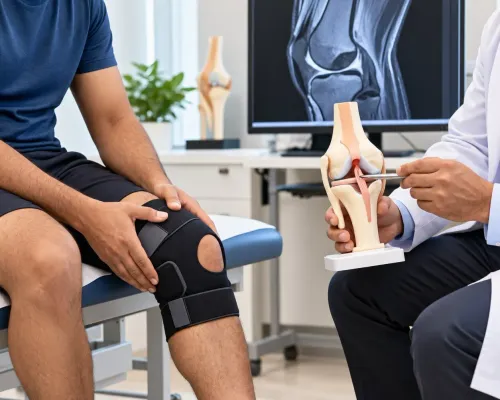
The standard assessment combines a medical history, physical examination and knee imaging; it is not a fixed blood-test package. Your surgeon checks that arthritis is limited to one compartment, the ligaments remain stable, the deformity is correctable and you can participate in rehabilitation.
| Assessment | Routine role | Ordered when it applies |
|---|---|---|
| Medical history and examination | Reviews medicines, allergies, bleeding history, heart and lung symptoms, infection, movement, strength and walking ability | Every patient |
| Knee X-rays | Confirm the damaged compartment and assess alignment and joint space | Every patient; the required views depend on the surgical plan |
| CBC, kidney function, electrolytes, glucose or HbA1c | Detect anaemia, kidney problems or poor glucose control | Diabetes, kidney disease, older age, symptoms or local protocol |
| Coagulation tests and blood typing | Assess bleeding risk and prepare for transfusion planning | Anticoagulant use, liver disease, bleeding history or hospital protocol |
| Pregnancy test | Prevents exposure to anaesthesia and imaging during pregnancy | Patients who could be pregnant, according to consent and local policy |
| ECG or chest X-ray | Not automatic in a healthy person without symptoms | Heart or lung disease, relevant symptoms, abnormal examination or risk factors |
| ESR, CRP, knee aspiration or MRI | Investigate a specific concern rather than routine screening | Suspected infection, unexplained symptoms or uncertainty about cartilage, menisci or ligaments |
These are the main tests before partial knee replacement surgery and partial knee replacement preoperative tests. An unexplained fever, draining skin lesion or active infection must be addressed before implantation. Whole-knee inflammatory arthritis, severe stiffness, neuropathy or major weakness can also change the operation or rehabilitation plan.
Which X-rays and scans confirm whether the knee is suitable?
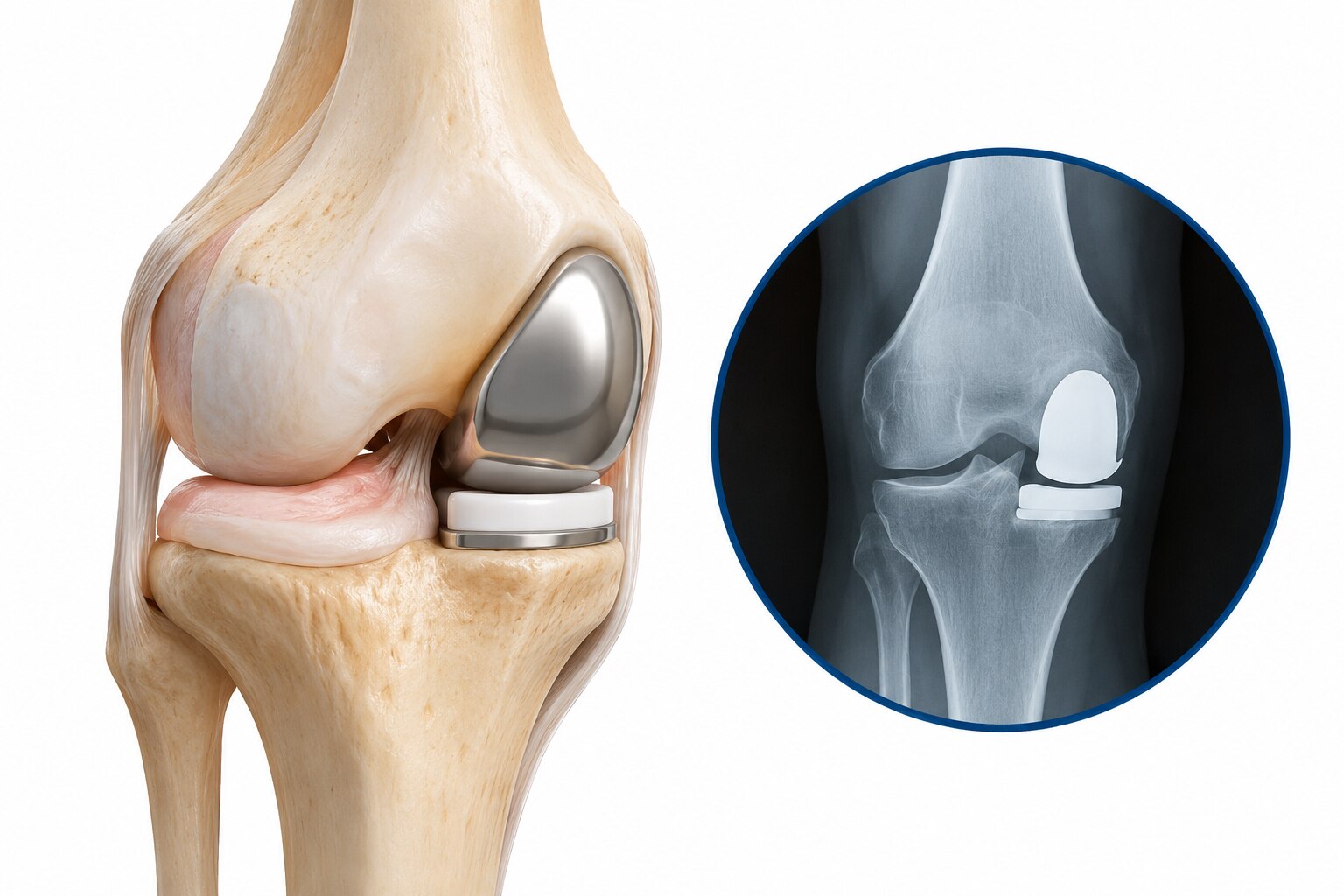
Weight-bearing X-rays usually provide the first and most important evidence for a partial knee replacement evaluation. Standing anteroposterior and lateral views show joint-space loss, osteophytes, bone defects and whether arthritis is confined to the medial, lateral or patellofemoral compartment. A flexion weight-bearing, or Rosenberg, view can reveal narrowing hidden when the knee is straight.
| Imaging test | What it shows | When it is needed |
|---|---|---|
| Standing AP and lateral X-rays | Weight-bearing joint-space loss, osteophytes and bone shape | Routine partial knee surgery assessment |
| Skyline, sunrise or Merchant view | The patellofemoral compartment and kneecap tracking | Routine assessment when front-of-knee arthritis matters |
| Full-length standing hip-to-ankle film | Varus or valgus alignment across the entire limb | When alignment must be measured or deformity is suspected |
| MRI | Cartilage in each compartment, menisci, ACL and other ligaments | When symptoms and X-rays disagree, diagnosis is uncertain, or another injury is suspected |
A full-length alignment film is not necessary for every patient. It becomes useful when the surgeon needs to measure the mechanical axis or decide whether the deformity is suitable for correction with a partial implant.
MRI does not make the decision by itself. Incidental meniscal tears and cartilage changes are common with age, so MRI findings must match your pain, examination and weight-bearing films. If high-quality X-rays already show isolated arthritis and the ligaments are clinically stable, MRI often adds no useful information.
What does the physical examination decide about partial replacement?
An examination can support a partial implant only when the symptoms and knee mechanics point to one damaged compartment while the rest of the knee remains usable. Inner-side pain suggests medial disease; outer-side pain suggests lateral disease; pain behind the kneecap points toward patellofemoral disease. Pain alone cannot prove suitability.
During a partial knee surgery assessment, the clinician checks:
- Whether pain is confined to the arthritic compartment rather than spread across the whole knee.
- Whether the knee bends and straightens adequately, and whether a fixed flexion deformity prevents full extension.
- Whether varus or valgus angulation corrects when the examiner gently moves the leg into alignment.
- Whether the anterior cruciate ligament (ACL) and collateral ligaments provide firm stability.
- Whether swelling, warmth, a wound, or other findings suggest active infection or inflammatory arthritis affecting the whole joint.
The examination cannot show cartilage directly. Weight-bearing X-rays, and MRI when the diagnosis remains unclear, must confirm that cartilage in the other compartments is preserved; an incidental meniscal tear or MRI abnormality does not automatically rule partial replacement in or out.
A flexible deformity and stable ACL favour a unicompartmental implant. A rigid deformity, marked ligament looseness, severe stiffness, or pain from multiple compartments points toward discussing total replacement instead. Shiva Orthopaedic Centre can use these findings, rather than an MRI report alone, to explain which operation fits your knee.
Which blood, urine, heart and anaesthesia checks are needed?
Tests before partial knee replacement surgery are selected from your health history, examination, medicines and local protocol. There is no universal blood-test package for every healthy patient.
| Test | What it checks | When it applies |
|---|---|---|
| CBC | Anaemia, infection clues and platelet count | If anaemia, bleeding risk, older age or medical conditions are present |
| Kidney function and electrolytes | Kidney performance and sodium or potassium balance | With kidney disease, diabetes, hypertension, relevant medicines or increased age |
| Glucose or HbA1c | Current glucose control and infection risk | For diabetes, high-risk symptoms or a raised previous result |
| Liver function | Liver disease affecting medicines or clotting | With known liver disease, heavy alcohol use or abnormal findings |
| Coagulation studies | Clotting problems | With bleeding history, liver disease or anticoagulant use |
| Urinalysis or urine culture | Possible urinary infection | If urinary symptoms exist; an incidental positive result should not automatically cancel surgery |
| ECG | Heart rhythm and signs of cardiac strain | With heart disease, symptoms, abnormal examination or relevant risk factors |
| Pulse oximetry | Resting blood oxygen level | With lung disease, breathlessness, sleep apnoea or low oxygen readings |
| Chest X-ray | Lung or heart abnormalities | With respiratory symptoms or known cardiopulmonary disease, not as a blanket test |
An anaesthesia review also checks previous anaesthetic problems, airway concerns, smoking, exercise tolerance and medicines that affect bleeding. Blood typing, pregnancy testing and extra cardiac or lung tests are ordered when your history makes them relevant.
These partial knee replacement preoperative tests identify risks that need treatment or planning rather than adding tests without a clear purpose.
When do additional tests point to total replacement or delay surgery?
A partial knee replacement evaluation needs targeted investigation when another condition could make implantation unsafe or change the operation. Active infection near the knee, fever, a draining skin lesion, or a hot swollen joint calls for ESR, CRP and knee aspiration for synovial white-cell count, differential and culture.
Delay surgery until infection is identified and treated.
Order focused tests when the history or examination raises a specific concern:
- Chest pain, fainting, unexplained breathlessness or poor exercise tolerance may require ECG, echocardiography, cardiac review or stress testing before anaesthesia.
- Breathlessness, low oxygen saturation, COPD, heavy smoking or a recent chest infection may require chest imaging, pulmonary-function tests and respiratory optimisation.
- Several swollen joints, prolonged morning stiffness, psoriasis or unusually rapid joint damage may require ESR, CRP, rheumatoid factor, anti-CCP antibodies and rheumatology review. Active inflammatory arthritis affecting the whole knee is a poor setting for a partial implant.
| Finding | What it suggests | Better next discussion |
|---|---|---|
| Arthritis in the medial, lateral and patellofemoral compartments | Disease is not confined to one compartment | Total knee replacement |
| Fixed varus or valgus deformity | Alignment cannot be corrected by examination | Total replacement or further planning |
| Marked ACL or collateral-ligament instability | The knee cannot support a unicompartmental implant | Total replacement |
| Severe stiffness or major muscle weakness | Rehabilitation and implant function may be limited | Delay, physiotherapy or total replacement |
This partial knee surgery assessment should also consider hip or spine disease and whether you can participate in postoperative physiotherapy. Partial knee replacement preoperative tests cannot compensate for an unsafe medical condition or a knee that is mechanically unsuitable.
Frequently asked questions
Which tests are routinely done before partial knee replacement?
Assessment usually includes your medical history, knee examination and standing X-rays. Blood, urine, heart and anaesthesia checks depend on your age, health conditions and hospital protocol.
Which X-rays and scans confirm whether the knee is suitable?
Weight-bearing knee X-rays show which compartment has arthritis, the joint space and leg alignment. Stress X-rays can show whether the deformity corrects and whether the opposite compartments remain preserved; MRI is used when X-rays do not answer a specific question.
What does the physical examination decide about partial replacement?
The examination checks ligament stability, knee range of motion, alignment, tenderness and whether the deformity is correctable. These findings help determine whether a partial implant can function properly.
Which blood, urine, heart and anaesthesia checks are needed?
Common checks include a complete blood count, kidney function, electrolytes, blood glucose and urine testing when indicated. An ECG, chest assessment and anaesthesia review are added according to your age, symptoms, medical conditions and planned anaesthetic.
When do additional tests point to total replacement or delay surgery?
Arthritis in multiple compartments, major ligament instability, a fixed deformity or unsuitable knee movement can favour total replacement. Anaemia, infection, uncontrolled diabetes, heart disease or another untreated condition can delay surgery until it is safer.
Keywords