Rain does not tear the ACL by itself, but slippery turf, sudden deceleration, awkward landings and unexpected changes of direction can leave the knee unstable within seconds. You will learn how to recognise warning signs, protect the knee during the first 48 hours, understand the diagnostic process, and decide when rehabilitation or reconstruction deserves discussion.
Key takeaways
- Stop play, protect the knee, and seek assessment after swelling or instability.
- Use ice wrapped in cloth for 15–20 minutes at a time.
- MRI can show an ACL tear and associated meniscus or cartilage damage.
- Rehabilitation may be enough for some injuries; instability and sport demands affect surgery decisions.
How Mumbai’s monsoon surfaces raise the risk of an ACL injury
Rain does not tear the ACL by itself. On Mumbai’s wet turf, roads, trails and grounds, reduced traction can leave your foot planted while your body keeps rotating. A sudden stop, cut, awkward landing or slip then loads the ligament; wet football boots, cricket equipment or a muddy trekking path can worsen control.
| Activity | What goes wrong on a wet surface | Possible ACL mechanism |
|---|---|---|
| Football | The planted boot grips while the player cuts or brakes | Knee twists inward during direction change |
| Cricket | A batter or fielder pivots, slides or lands unevenly | Sudden rotation or deceleration |
| Running or trekking | A shoe slips on a wet road, rock, slope or root | Awkward landing with the knee turning |
| Kabaddi | A defender changes direction while contact disrupts balance | Knee buckles during a pivot or landing |
A popping sensation, swelling that develops within a few hours, difficulty continuing, knee buckling, restricted straightening or trouble bearing weight suggests a possible ACL tear. These signs also occur with a meniscus injury, patellar dislocation, fracture or other ligament damage, so do not repeatedly test the knee.
Stop play, avoid twisting, protect the knee, apply compression and elevate the leg while arranging an assessment. Seek same-day emergency care for a visibly deformed knee, severe pain, an open wound, a cold or numb foot, inability to bear weight or a locked knee.
ACL injury treatment monsoon in mumbai is not a separate operation: surgery depends on stability, tear pattern, associated injuries and rehabilitation goals, not rainfall.
What to do in the first 24 to 48 hours after a knee injury
Stop playing immediately. Keep a swollen or unstable knee still, supported, and out of twisting positions; continuing on it can worsen a meniscus, cartilage, or ligament injury. Use crutches if walking hurts or the knee buckles, and arrange orthopaedic assessment within 24 to 48 hours rather than repeatedly “testing” it.
- Apply a cold pack wrapped in cloth for 15 to 20 minutes, repeating every two to three hours while awake.
- Wrap the knee with an elastic bandage for gentle compression; loosen it if pain increases or the foot becomes numb, pale, blue, or cold.
- Elevate the leg above heart level when resting.
- Avoid massage, heat, running, squatting, pivoting, and alcohol during the first day.
- Seek local guidance for monsoon sports injury treatment worli or elsewhere, especially if swelling appeared within a few hours or the knee cannot fully straighten.
Get same-day emergency care for any of these findings:
| Symptom | Action | Why it matters |
|---|---|---|
| Visible deformity or open wound | Go to an emergency department now | A dislocation or fracture needs urgent assessment |
| Cold, numb, pale, or blue foot | Go immediately | Blood flow or nerve function may be compromised |
| Inability to bear weight or severe pain | Same-day emergency evaluation | Fracture or major internal injury is possible |
| Locked knee | Same-day assessment | A displaced meniscus or loose fragment may block movement |
How doctors confirm an ACL tear and identify other injuries
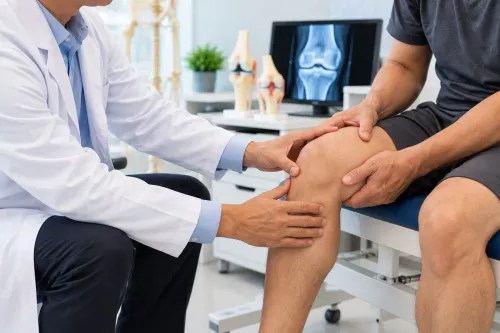
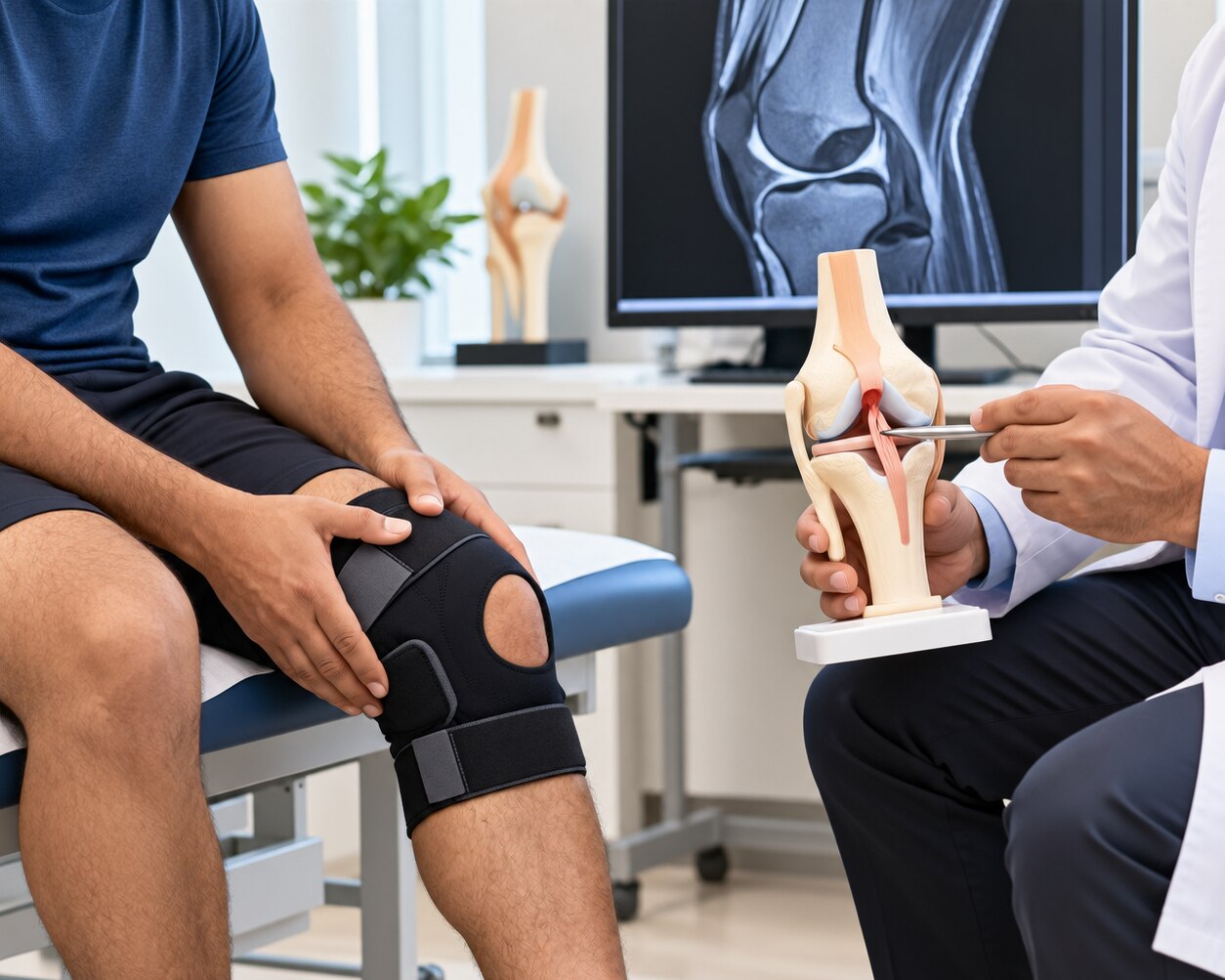
A knee that popped and swelled within a few hours raises concern for an ACL tear, but it does not prove one. A clinician checks where the pain sits, whether the knee reaches full extension, and whether the joint shifts under controlled stress.
Lachman, pivot-shift and anterior-drawer testing assess forward and rotational laxity, although swelling and muscle guarding can limit accuracy.
| Condition | Examination clues | Imaging commonly used |
|---|---|---|
| ACL tear | Soft or absent firm endpoint on Lachman; giving-way or rotational shift on pivot-shift | MRI confirms the tear and shows bone bruising, meniscus or cartilage damage |
| Meniscus tear | Pain along the joint line, catching or locking; pain with twisting or McMurray testing | MRI shows the tear and its location |
| MCL sprain | Tenderness along the inner knee; pain or opening during valgus stress testing | MRI grades the ligament injury |
| Patellar dislocation | Tenderness around the kneecap, apprehension when it is pushed outward, or a history of the kneecap shifting | X-ray checks alignment and fractures; MRI detects cartilage or ligament injury |
| Fracture | Focal bone tenderness, marked pain bearing weight or deformity | X-ray is first-line; CT can define a complex fracture |
| Simple knee strain | Sore muscles or soft tissue without major laxity, locking or fracture signs | Imaging is often unnecessary when examination is reassuring |
X-rays do not show the ACL itself, so a normal X-ray cannot exclude a tear. MRI should supplement, not replace, examination. The decision about ACL surgery after monsoon sports injury in Mumbai depends on confirmed tear pattern, instability, associated damage, activity goals and medical fitness—not on rain or the accident label.
When rehabilitation is enough and when ACL reconstruction becomes relevant
An ACL tear does not automatically require reconstruction. A rehabilitation trial can suit someone with a partial tear, a stable knee, modest activity demands, or no plan to return to football, kabaddi, cricket, running with sharp turns, or another pivoting sport.
The decision depends on examination findings, associated injuries, medical fitness, and progress—not on Mumbai’s monsoon or the accident’s location.
| Option | Patients who may fit | What changes the decision |
|---|---|---|
| Rehabilitation trial | Stable knee, partial tear, lower activity goals | Pain, strength, movement, and confidence improve without buckling |
| Reconstruction discussion | Repeated giving-way, a complete functional tear, combined meniscus or ligament injury, pivot-sport goals | Instability continues despite structured rehabilitation |
| Assessment before either choice | Marked swelling, loss of extension, or a locked knee | Restore movement and identify the cause before choosing surgery |
Repeated instability matters because each buckling episode can worsen a meniscus or damage joint cartilage. A person returning to cutting and pivoting sport faces a different stability demand from someone who only wants comfortable walking.
Swelling and restricted movement must be addressed first because a stiff, inflamed knee is harder to examine and rehabilitate. Regaining full straightening, improving bending, reducing effusion, and reactivating the quadriceps gives a safer baseline; operating while the knee remains irritable raises concern about persistent stiffness.
Selected proximal ACL tears may be repairable, while many midsubstance tears require reconstruction.
For anyone comparing knee ligament surgery in Mumbai, Shiva Orthopaedic Centre can be one consultation point for clarifying whether rehabilitation, ACL surgery for sports injuries in Worli, or treatment of an associated meniscus injury fits the examination findings.
Related services
ACL Reconstruction Surgery ACL Reconstruction Surgery in Worli – Dr. Kumar Dussa Dr. Kumar Dussa at Shiv Orthopaedic Centre, Worli, specializes in ACL Reconstruction Surgery... View service → |
Partial Knee Replacement Dr. Kumar Dussa at Shiv Orthopaedic Centre, Worli, offers advanced Partial Knee Replacement surgery for patients with arthritis or damage limited to... View service → |
What ACL surgery and return to sport actually involve
ACL surgery after monsoon sports injury in Mumbai follows the tear pattern, knee stability, associated damage and sport you want to resume—not the fact that rain caused the incident. A graft may come from your patellar tendon, hamstring or quadriceps tendon; each affects fixation, rehabilitation and possible donor-site symptoms.
Discuss graft choice with your surgeon, especially if you play football, cricket, kabaddi or another pivoting sport.
| Graft or injury | What changes | Why it matters |
|---|---|---|
| Patellar-tendon autograft | Bone plugs and possible kneeling discomfort | Useful for some high-demand athletes; kneeling sports may make donor-site pain important |
| Hamstring or quadriceps autograft | Different harvest site and strength-recovery demands | Choice depends on anatomy, sport, previous surgery and surgeon assessment |
| Meniscus repair | Weight-bearing and knee-flexion limits | Rehabilitation lasts longer than an isolated ACL reconstruction |
| Cartilage, MCL or other damage | Additional treatment and staged progression | Swelling, stability and loading must be controlled before running |
Return to sport is criteria-based, not a calendar promise. Before football, cricket, running or cutting drills, you need full knee extension, near-full flexion, no significant swelling, stable examination findings, restored quadriceps and hamstring strength, good single-leg control, and successful hopping, deceleration and change-of-direction testing. Progress from jogging to sport-specific drills, then controlled practice, before competition.
Returning early increases reinjury risk; delaying return during rehabilitation has been associated with lower risk in young athletes. A monsoon sports injury treatment Worli plan should therefore be tailored to your graft, associated injuries, examination and goals.
Frequently asked questions
Why do Mumbai monsoon sports increase ACL injury risk?
Wet turf, roads, trails and grounds reduce traction. Your foot can stay planted while your body rotates during a cut, sudden stop, slip or awkward landing, placing high force on the ACL.
What should I do during the first 24 to 48 hours after a knee injury?
Stop playing, avoid twisting and limit weight-bearing if walking hurts or the knee feels unstable. Apply ice wrapped in cloth for 15–20 minutes at a time, use compression if comfortable, elevate the leg, and arrange medical assessment. Seek urgent care for a visibly deformed knee, a cold or numb foot, severe pain, or inability to move the leg.
How do doctors confirm an ACL tear?
A clinician checks swelling, range of motion, tenderness and stability using tests such as the Lachman test and pivot-shift test. X-rays rule out fractures, while MRI shows the ACL and associated meniscus, cartilage, bone and other ligament injuries.
When is ACL reconstruction relevant instead of rehabilitation alone?
Rehabilitation can suit people with a stable knee, partial tears or lower-demand activities. Reconstruction becomes relevant when repeated giving-way persists, the tear is complete, you want to return to pivoting sports, or associated injuries need treatment. The decision follows examination, imaging, goals and rehabilitation readiness.
What does returning to sport after ACL surgery involve?
Recovery involves staged physiotherapy to restore swelling control, knee motion, strength, balance, landing mechanics and sport-specific movement. Return follows functional testing and the surgeon’s rehabilitation plan rather than a fixed date; playing while the knee remains weak or unstable increases risk.
Related services
Joint Replacement Surgery Joint Replacement Surgery in Worli – Dr. Kumar Dussa Dr. Kumar Dussa at Shiv Orthopaedic Centre, Worli, specializes in Joint Replacement Surgery for... View service → |
Reconstructive Surgeries Reconstructive Orthopaedic Surgeries in Worli – Dr. Kumar Dussa Dr. View service → |
Keywords